AllAI & MLRoboticsAutonomy3D PrintingElectrificationSafetyWorkforceMaterialsEDITOR'S PICKWEEKLY DISPATCH
Category

Workforce & Labor

Labor shortage, skilled trades, apprenticeships, hiring platforms, workforce development, and crew management.

1202 stories found

Construction's structural labor crisis has crystallized into an unmistakable competitive sorting mechanism that now explicitly divides operators who've architected integrated talent systems from those still fragmenting efforts across disconnected initiatives. The convergence of three forces is reshaping the entire industry: persistent labor scarcity that refuses cyclical relief, intensifying regulatory enforcement that transforms safety compliance into a non-negotiable operational requirement, and technology adoption that separates strategic workforce planners from those still relying on manual processes. Contractors embedding psychological capital development—the renewable resource combining hope, efficacy, resilience, and optimism identified by the American Psychological Association—alongside safety culture, wellness programming, and technology implementation are demonstrating measurably superior retention outcomes precisely as competitors continue hemorrhaging workers to attrition. The data is unambiguous: firms managing labor strategically through integrated systems now capture talent at scale, while those treating workforce development as a disconnected cost center are fragmenting against wider performance gaps that cannot be bridged by margin compression from material cost inflation.

Technology adoption has shifted decisively from implementation barrier to retention lever as purpose-built solutions designed for trade-level adoption rather than corporate mandate reshape labor dynamics across estimation, scheduling, and field operations. ConstructConnect's automated takeoff capabilities cut estimation time by 50% on large projects while freeing estimator bandwidth for strategic opportunity scoring, eSUB's partnership with SMART Local 104 is embedding project management skills directly into sheet metal apprenticeships, and MasTec's deployment of physical AI on solar construction jobsites demonstrates on-site operation optimization beyond corporate-level forecasting. The gap between early adopters systematizing these capabilities and lagging competitors remains a decisive competitive moat—yet implementation barriers and workforce skills gaps simultaneously create immediate opportunity for operators willing to integrate training alongside technology deployment. Bluebeam's 2027 AEC technology report confirms most construction firms haven't scaled these capabilities, a condition that reflects organizational friction but masks exceptional runway for contractors positioned to move first.

The talent acquisition and retention crisis now operates entirely on a different plane than wage competition alone can address. Procore's research reveals 50% of young people believe AI could enhance construction careers, yet 41% remain unaware the industry already uses AI—a marketing gap that contractors actively communicating technological enhancement of labor can exploit for talent acquisition at scale while competitors remain silent. Meanwhile, the Department of Labor's reinstatement of the economic reality test for independent contractor classification, the BlackRock Foundation's new veteran transition program, and expanded federal apprentice payment programs signal sustained commitment to training infrastructure scaling precisely as construction employment rose across 37 states. The industry's competitive architecture has fundamentally reorganized: firms treating safety, wellness integration, and technology implementation as interconnected systems that explicitly enhance worker experience and career trajectory are establishing sustainable performance advantages that low-cost operators cannot replicate. This is no longer construction's labor shortage; it is construction's talent development divide.

WEEKLY DISPATCH
1X begins production of NEO humanoids in California facility
Robotics Business Review·May 6, 2026

1X begins production of NEO humanoids in California facility

1X has opened a California manufacturing facility to produce NEO humanoid robots at full scale, marking a major shift toward domestic humanoid robot production in the U.S. The vertically integrated factory positions the company to supply robots for construction and other industries seeking automation solutions.


RoboticsWorkforce
Construction Jobs Increase In 33 States And D.C. Between March 2025 And March 2026; 31 States And D.C. Add Jobs In March
AGC of America News·May 6, 2026

Construction Jobs Increase In 33 States And D.C. Between March 2025 And March 2026; 31 States And D.C. Add Jobs In March

Construction employment grew in 33 states and Washington D.C. over the year from March 2025 to March 2026, demonstrating broad strength across the industry. In March alone, 31 states and D.C. added construction jobs, indicating sustained momentum in the sector.

Workforce
Five Ways to Integrate Mental Health Into Construction Safety Protocols
Construction Executive·May 5, 2026

Five Ways to Integrate Mental Health Into Construction Safety Protocols

Construction companies should weave mental health considerations into their safety protocols as part of a comprehensive approach to worker wellbeing. Addressing mental health alongside physical safety helps create a healthier, more resilient workforce on job sites.

Workforce
4 Major Challenges Facing the Construction Industry in 2026
ConstructConnect·May 5, 2026

4 Major Challenges Facing the Construction Industry in 2026

The construction industry faces four significant obstacles in 2026 that will impact project delivery and profitability. Labor shortages, supply chain disruptions, rising material costs, and technology adoption gaps are the primary headwinds contractors must navigate.

WorkforceMaterials
ABB Robotics launches OmniVance autonomous surface finishing cell
Robotics Business Review·May 4, 2026

ABB Robotics launches OmniVance autonomous surface finishing cell

ABB Robotics introduced the OmniVance Collaborative Surface Finishing Cell, which automates sanding and polishing work that is typically repetitive and labor-intensive. The autonomous cell handles surface finishing tasks that contractors currently perform manually, potentially reducing labor demands on job sites.

RoboticsAutonomy
Readers’ Poll: Construction Hiring Challenges Driven by Lack of Skilled Candidates
Equipment World·May 4, 2026

Readers’ Poll: Construction Hiring Challenges Driven by Lack of Skilled Candidates

Nearly 7 in 10 construction firms report that finding experienced workers is their biggest hiring obstacle heading into 2026. The skilled labor shortage continues to be a critical challenge for companies trying to staff their projects and grow their operations.

Workforce
What is a construction work order? Types, components, and how to use them
Fieldwire Blog·May 1, 2026

What is a construction work order? Types, components, and how to use them

A construction work order is a documented authorization that details specific tasks, materials, costs, and timelines for a job or project phase. Work orders serve as essential operational tools that coordinate labor, track costs, and ensure all team members understand what needs to be completed and when.

Workforce
Contractors to Pay Record $1.28M for Wage Violations in Minnesota
Equipment World·Apr 30, 2026

Contractors to Pay Record $1.28M for Wage Violations in Minnesota

The construction projects included the upscale, mixed-use development by the owners of the Minnesota Vikings near the NFL team's...

Workforce
Why your Excel construction daily report form may be creating more cost than you realize
Fieldwire Blog·May 1, 2026

Why your Excel construction daily report form may be creating more cost than you realize

Manual Excel daily reports on construction sites waste crew time and introduce data entry errors that compound into significant cost overruns. Switching to automated reporting systems can reduce administrative burden and improve project cost visibility and accuracy.

Workforce
Takeoff Software for Lean Preconstruction Teams: A Complete Guide
Autodesk Construction Cloud Blog·Apr 29, 2026

Takeoff Software for Lean Preconstruction Teams: A Complete Guide

Accurate material takeoffs are critical to project profitability, as even small errors in counts or missed items can eliminate margins and cost you bids. Takeoff software helps lean preconstruction teams streamline this foundational estimating process to reduce mistakes and improve bid accuracy.

Workforce
How to choose subcontractor project management software that actually gets used in the field
Fieldwire Blog·May 1, 2026

How to choose subcontractor project management software that actually gets used in the field

Choosing subcontractor management software requires prioritizing tools that field crews will actually adopt rather than fancy features that sit unused. Key factors include ease of use, mobile accessibility, integration with existing workflows, and vendor support that keeps workers engaged.

Workforce
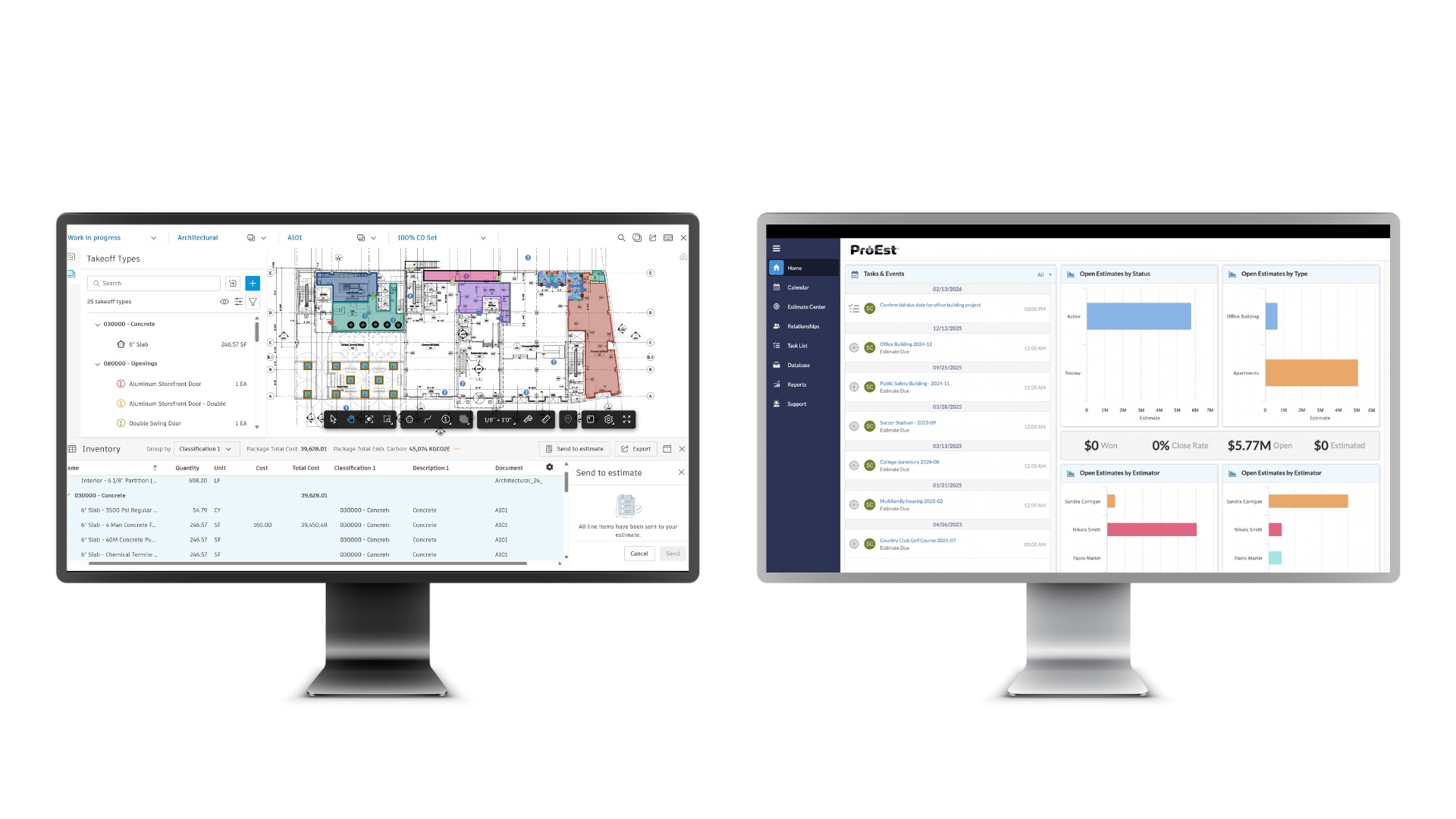
Forma Estimate vs. ProEst: Key Differences for Preconstruction Teams
Autodesk Construction Cloud Blog·Apr 29, 2026

Forma Estimate vs. ProEst: Key Differences for Preconstruction Teams

Modern estimators need software that balances speed and accuracy while handling complex projects and delivering strategic insights beyond basic cost calculations. Forma Estimate and ProEst are two preconstruction platforms designed to meet these evolving demands for estimating teams.

Workforce
What's the Difference Between ConstructConnect® and Procore®?
ConstructConnect·Apr 28, 2026

What's the Difference Between ConstructConnect® and Procore®?

ConstructConnect and Procore serve different phases of construction projects, with ConstructConnect handling preconstruction and bidding while Procore manages post-award execution and active project management. Understanding which tool fits your workflow depends on whether you need support before or after a project is awarded.

Workforce
Fabrication Shops Should Be Operating Like High-Performance Manufacturers
Construction Executive·Apr 28, 2026

Fabrication Shops Should Be Operating Like High-Performance Manufacturers

Fabrication shops can improve efficiency and cut waste by adopting high-performance manufacturing strategies. Strategic operations also help address the ongoing skilled-labor shortage in construction.

WorkforceMaterials
Construction workers still aren’t seeking mental health help, here’s why
Fieldwire Blog·Apr 28, 2026

Construction workers still aren’t seeking mental health help, here’s why

Construction workers face significant barriers to accessing mental health support, including workplace stigma, lack of awareness about available resources, and financial constraints. Addressing this gap requires industry-wide efforts to normalize mental health conversations and make treatment more accessible on job sites.

Workforce
6 Ways to Increase Productivity at Your Manufacturing Facility
ConstructConnect·Apr 27, 2026

6 Ways to Increase Productivity at Your Manufacturing Facility

Manufacturing facilities can boost output through strategic improvements in operations and equipment management. The article outlines six practical approaches to streamline workflows and maximize efficiency on the production floor.

Workforce
Water, sewer contractor and major homebuilder make ‘Dirty Dozen’ list
Construction Dive·Apr 24, 2026

Water, sewer contractor and major homebuilder make ‘Dirty Dozen’ list

Revoli Construction and D.R. Horton landed on the National Council for Occupational Safety and Health's 'Dirty Dozen' list for major safety violations in their operations. The designation highlights ongoing safety compliance issues among significant players in water, sewer, and homebuilding sectors.

Workforce
4 Common Risk Factors on Construction Projects for General Contractors
ConstructConnect·Apr 26, 2026

4 Common Risk Factors on Construction Projects for General Contractors

General contractors face four key risk factors on construction projects that can impact project success and profitability. Understanding and managing these risks—whether related to safety, scheduling, budget, or workforce—is essential for maintaining operational efficiency on job sites.

SafetyWorkforce