AllAI & MLRoboticsAutonomy3D PrintingElectrificationSafetyWorkforceMaterialsEDITOR'S PICKWEEKLY DISPATCH
Category

3D Printing & Prefab

3D printed buildings, concrete printing, prefabrication, modular construction, and offsite manufacturing.

278 stories found

The production scaling thesis that anchored institutional confidence in construction additive manufacturing now extends definitively into repeat manufacturing workflows where commercial viability and operational predictability have replaced experimental validation as the primary organizing principle. 3T-AM's shift toward production orders—now representing 70% of revenue—exemplifies the market maturation that follows successful technical validation: manufacturers are no longer managing additive manufacturing as prototype infrastructure but embedding it into standard production capacity planning. This transition from exception-based project work to continuous manufacturing operations fundamentally reshapes how construction organizations should evaluate additive manufacturing partnerships, shifting evaluation criteria from technical capability demonstrations toward supplier reliability, inventory management capacity, and integration with existing procurement workflows. Simultaneously, the supporting infrastructure for design-to-production optimization continues strengthening through both process-level improvements—where ML-accelerated optimization continues transforming wire arc additive manufacturing from experimental methodology into viable large-format production pathway—and design-layer tools like Meshy Edit, which collapse the iterative modeling cycles that previously created scheduling friction between design intent and fabrication readiness.

Modular production capacity now emerges as the critical operational variable that transforms additive manufacturing from fixed-asset constraint into scalable infrastructure. AltForm's introduction of the ZENIT Modular directed energy deposition system, available in configurations scaling from 2 x 2 meters to 4 x 4 meters with expandable capability, provides construction-relevant manufacturers with deployment flexibility previously unavailable in large-format metal additive manufacturing. This expandable architecture directly addresses the capital planning constraint that limited adoption among mid-market contractors: organizations can now initiate additive manufacturing production at operational scale compatible with current demand, then incrementally scale capacity as repeat orders justify infrastructure expansion. Combined with established supply chain validation for mission-critical materials—titanium alloys, tungsten carbide, aluminum structures—the operational landscape now confirms that construction additive manufacturing has transitioned from experimental exception handling into mature production methodology.

For construction executives evaluating long-term materials partnerships and equipment strategies, the competitive variable has crystallized around organizational capacity to embed additive manufacturing into standard procurement and design protocols rather than pursue isolated project applications. Organizations that establish material specifications compatible with available production capacity, invest in design tools that streamline iterative modeling workflows, and partner with manufacturers treating additive manufacturing as continuous production infrastructure—rather than project-based capability—will continue capturing returns on integration investment. The remaining constraint is no longer technical feasibility but organizational readiness to treat additive manufacturing systems as standard manufacturing assets rather than specialized exceptions.

3D People deploys AMIS Runtime to automate additive manufacturing build preparation
3D Printing Industry·Mar 10, 2026

3D People deploys AMIS Runtime to automate additive manufacturing build preparation

UK additive manufacturing service provider 3D People has deployed AMIS Runtime, a programmable build preparation engine, across its London production facility. Announced on March 3, 2026, the deployment integrates automated build preparation into the company’s polymer powder bed fusion production…
3D Printing
Your future home might be framed with printed plastic
MIT News – Construction/Architecture·Feb 3, 2026

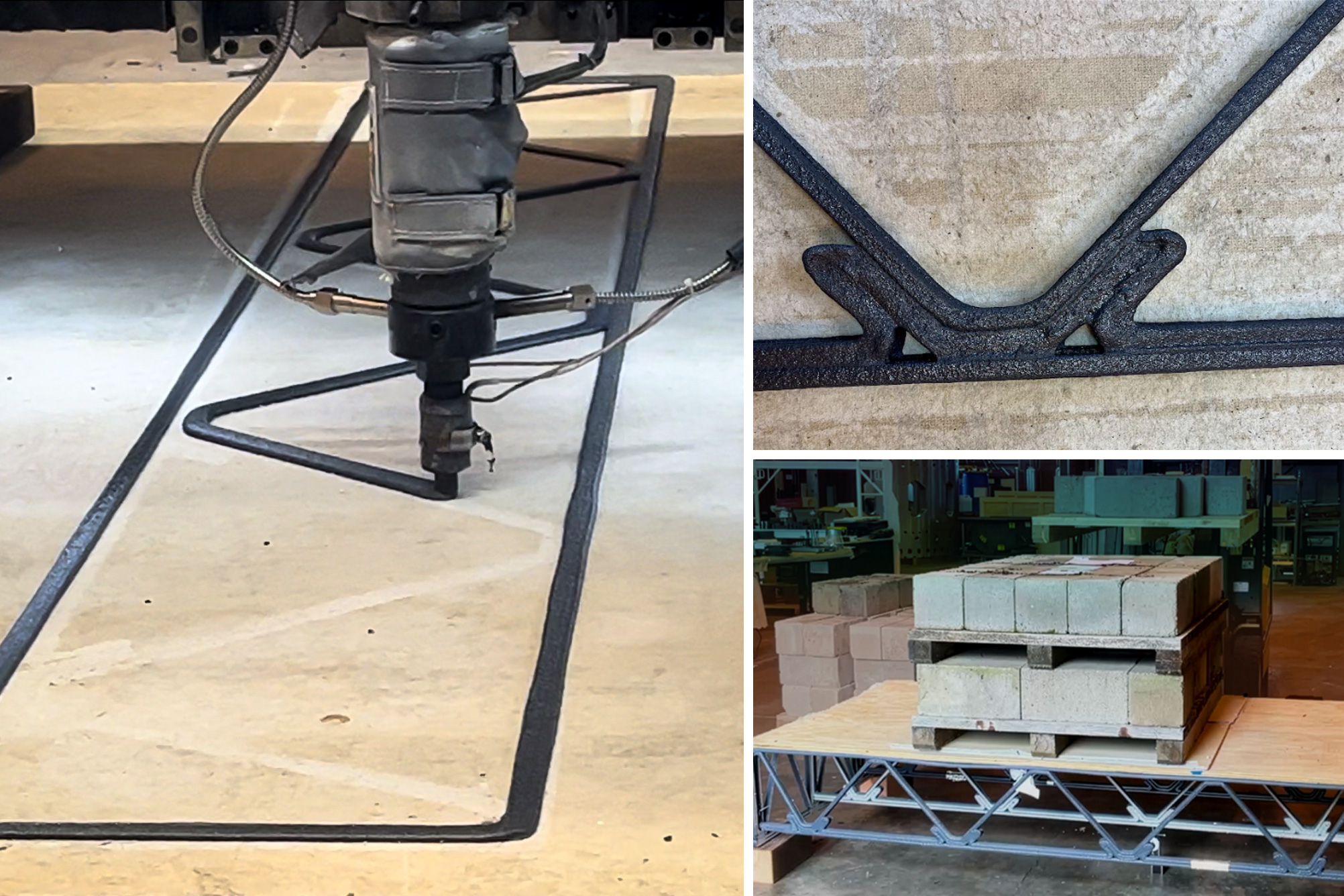
Your future home might be framed with printed plastic

MIT engineers are using recycled plastic to 3D print construction-grade floor trusses.

3D Printing
INTERVIEW: Will Perseus Materials’ Bet on Self-propagating Chemistry be “world’s fastest” Composite Manufacturing Technology?
3D Printing Industry·Mar 9, 2026

INTERVIEW: Will Perseus Materials’ Bet on Self-propagating Chemistry be “world’s fastest” Composite Manufacturing Technology?

Perseus Materials, a Stanford spinoff, is developing a continuous composite manufacturing process that uses self-propagating chemistry to produce structural parts without requiring ovens, autoclaves, or molds. The technology claims to be the industry's fastest composite manufacturing method and can create parts larger than the equipment itself.

3D PrintingMaterials
Walmart Strikes Deal for 3D-Printed Buildings from Alquist in Boost for Emerging Sector
ENR Construction Technology·Dec 15, 2025

Walmart Strikes Deal for 3D-Printed Buildings from Alquist in Boost for Emerging Sector

Walmart has contracted with construction tech firm Alquist to 3D-print over a dozen buildings, marking a significant commercial adoption of additive manufacturing in retail construction. The deal demonstrates growing viability of 3D printing technology for large-scale commercial projects and signals momentum for the emerging sector.

3D Printing
Technical Review: Evaluating 3D Fuel Pro PCTG for Engineering FDM Applications
3D Printing Industry·Mar 9, 2026

Technical Review: Evaluating 3D Fuel Pro PCTG for Engineering FDM Applications

This article presents a technical evaluation by the 3D Printing Industry engineering team of 3D Fuel’s Pro PCTG, a high-performance thermoplastic filament developed for FDM printing. Pro PCTG is a glycol-modified copolyester engineered to deliver improved toughness, dimensional stability, chemical…

3D Printing
Making Volumetric Modular Construction Work
AEC Business·Aug 25, 2025

Making Volumetric Modular Construction Work

Is volumetric modular construction on the verge of a breakthrough, or will it remain experimental or occasional, as it has so far in many countries? The post Making Volumetric Modular Construction Work appeared first on AEC Business .

3D Printing
Kaneko Optical Launches UROKO, a New 3D Printed Eyewear Collection for ISSEY MIYAKE MEN SS26
3D Printing Industry·Mar 9, 2026

Kaneko Optical Launches UROKO, a New 3D Printed Eyewear Collection for ISSEY MIYAKE MEN SS26

Kaneko Optical, a Japanese eyewear brand, has used 3D printing to translate the surface language of Japanese ceramics into wearable form, releasing UROKO, a new limited eyewear model for Japanese designer ISSEY MIYAKE MEN’s Spring Summer 2026 “DANCING TEXTURE” collection, where…

3D PrintingSafety
The Timber Tech Playbook: Lessons from Greg Howes
AEC Business·Aug 13, 2025

The Timber Tech Playbook: Lessons from Greg Howes

In this episode of the AEC Business podcast, I sit down with Greg Howes to discuss the future of mass timber construction in the US. The post The Timber Tech Playbook: Lessons from Greg Howes appeared first on AEC Business .

3D PrintingMaterials